


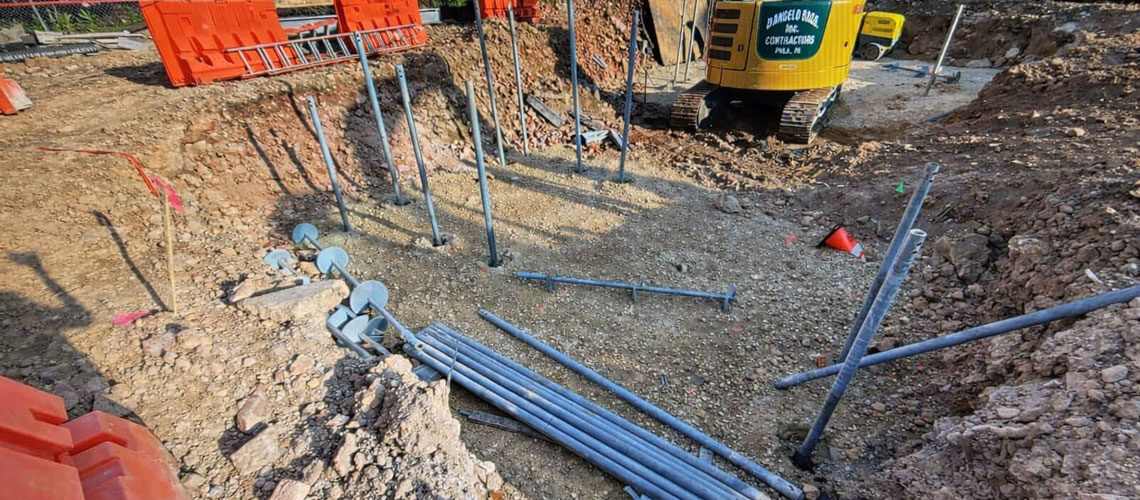
The concept of “Value Engineering” is well-known to the engineering and construction industries: an alternative design that can accomplish the same outcome at a lower cost. Increasingly, helicals have been looked to when an initial fix proves to be unworkable, expensive, or challenged. This was the case on a recent project in Philadelphia, PA.
The Forman Arts Initiative is a non-profit that supports local artists and their communities. Recently, Forman Arts purchased a property, totaling 100,000 square feet, of a former Philadelphia Electric Company substation in the Kensington neighborhood. This location will serve as the anchor for the organization and construction has begun on several projects.
Micropiles were the first choice to support a canopy for an outdoor exhibit area. The area was the site of a previously demolished structure and debris, trash, or obstacles subsurface were suspected. This was confirmed by the borings (Ingram Engineering Services) and included in a field report by Structural Engineers, Keast & Hood. Now, the micropiles specified for the urban fill were going to be much more challenging to install, as well as a costly option. It was at this point that GC, Intech, reached out to DBI for a look at a helical alternative.
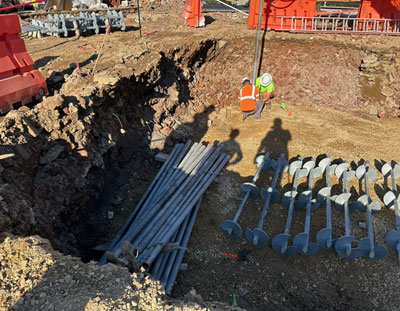
Danbro and our contractor network have extensive experience working in metropolitan areas like Philadelphia with frequent encounters with urban fill. After reviewing the borings and field report, Danbro recommended a transition pile with a smaller section modulus square shaft lead SS 175(1 3/4”), transitioning to 2 7/8” pipe extensions, to deal with the lateral component (2 kips) at the surface. A square shaft lead deals better with trash sites as it can more easily push through cobbles or demolition debris and even walk around a small object the size of a breadbox and get back on center. Pipe does better in the lower blow count material at the surface to deal with lateral. This is the reason Danbro recommends this pile combination in these conditions.
Geostructures was hired as the inspector since decisions had to be made on-site when piles snapped (3) and/or spun out (1) before achieving torque. Helicals that spin out can be backed out and moved to another location. These issues are not uncommon in sites where previous structures have been demolished. The simple answer is to add additional piles and/or relocate them and/or excavate to remove the obstruction. The latter was unnecessary because the first two options dealt with the issues on this site.
This is not the first encounter with urban fill sites or with helicals as a VE solution to address high-cost foundations. Below are several case studies highlighting the use of helicals as cost-saving alternates to more traditional foundations. As is typical with most of these examples, there were other considerations driving the decision with sometimes the cost savings as a happy bonus. This is because helicals bring more than just reduced cost savings to the VE equation. They offer other key advantages including, but not limited to, improved access, mobilization mitigation, no vibration, multiple pile options, and neighbor-friendly installations. This is why Helicals put “True Value” in Value Engineering.
500 Unit Housing Complex | Danbro Distributors
304 Johnson Ave (Hale Built) | Danbro Distributors
Stone Harbor Police Station | Danbro Distributors



[…] Helical underpinning piles provided the ideal engineering solution by addressing every site and soil constraint simultaneously: displacement-free and vibrationless installation, modular low-headroom advancement, immediate load transfer upon lock-off, and torque-correlated axial capacity verification without waiting for grout or concrete cure times. […]