


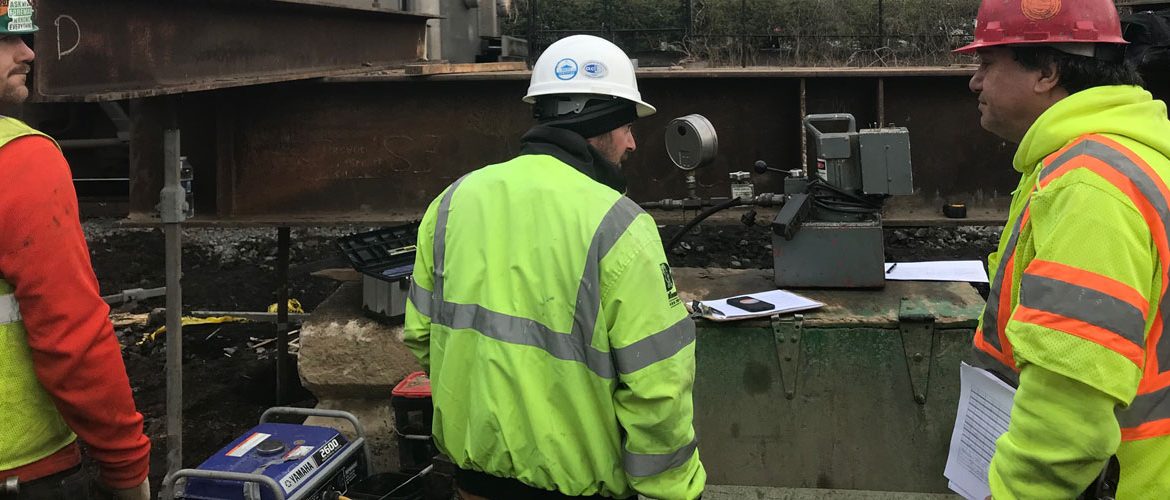
Torque correlation is the everyday capacity record for helical piles. A load test is the proof. On most projects the two work together – torque on every production pile, a load test on a representative one to confirm the correlation holds in that soil. For STELCOR Drilled-In Displacement Micropiles, the test pile does even more: it establishes the installation parameters the production piles will follow.
The SEPTA load test in Conshohocken was the first time SEPTA used this technology, which is why the load test mattered, and it happened on one of the least forgiving job sites in the region. With track outages, limited time near the rail, and no spoils blown out of the hole as with a traditional drilled pile, STELCOR was a good value-engineered solution, and SEPTA has specified the technology for future jobs. The design, by Steve Gencorelli, P.E., replaced a single cantilevered caisson at each support location with two STELCOR piles, because one pile could not carry the moment at the top of the caisson.
The Site: A New Platform Beside a Hot Rail
SEPTA was constructing a new train platform on its Conshohocken line. The foundation had to be verified before the platform went up, which meant a load test on site – with active trains passing throughout the day on the adjacent track.
A hot-rail environment removes options quickly. Driven piles are out on vibration alone; the track, the signals, and the passing trains cannot tolerate it. Conventional drilled micropiles produce spoils that have to be handled and hauled from a railroad right-of-way, often as contaminated material.
Overhead clearance, lateral clearance to the live track, and the safety protocols SEPTA requires all compress the working envelope further. Everyone on site – the installing crew, the inspecting engineers, and SEPTA’s representatives – worked under extra caution for the duration.
STELCOR was selected because its installation profile fits that envelope exactly.
Why a Displacement Micropile Develops Capacity at 18 Feet
The number that stops engineers on this page is the depth. A 128-kip ultimate capacity at 18 feet of embedment is shallow for that load, and the reason is the installation mechanism, not the soil.
STELCOR is installed as a displacement pile. Per IDEAL’s product data, the patented lateral displacement head densifies the surrounding soil as the pile advances rather than removing it – no spoils come out of the ground. The displaced, compacted soil locks against the grout column that forms around the full-length 80 ksi steel core as the pile is drilled in.
The result is a pile that develops capacity through both end bearing and a bonded, densified shaft, which is why it reaches high loads at depths where a conventional micropile would still be drilling.
IDEAL’s published testing for the STELCOR line runs to 620 kips in compression, 600 kips in tension, and 40 kips lateral. The SEPTA pile was not pushed to those limits; it was tested to the capacity the platform required, and it got there at 18 feet.
The test piles were the STELCOR SC1600 series (catalog SC1600-550361-3): a 16-inch grout column around a 5.5-inch OD, 0.361-inch wall, 80 ksi steel core, with a 13-inch displacement plate, an 18-inch drive plate, and an 8-inch reverse auger. They were built from a 7-foot lead and 7-foot extensions to total lengths of 17 to 20 feet, with a design load of 64 kips in compression, 4 kips in tension, and 3.5 kips lateral. The 128-kip ultimate is twice the 64-kip compression design load, matching the factor of safety of 2.0 the design called for.
What the Load Test Established
A static load test on a helical or displacement pile does three things, and the SEPTA test is a good lens for all of them.
It confirms the capacity. The program at Conshohocken covered six test locations, each marked as a pair of piles (TP 101/102, 116/117, and 133/134 inbound; 201/202, 216/217, and 233/234 outbound), loaded in quick tests: lateral at all six locations, compression at four, and tension at two. Loads were applied with a 150-ton jack and a 10,000 psi gauge, both calibrated and certified against a NIST-traceable reference, so the load numbers hold up to review. At Conshohocken, the pile carried 128 kips.
It sets the installation criteria. IDEAL’s installation guidance for STELCOR is explicit that pile capacity is not determined by installation torque, and that torque data is for reference. The test pile is what establishes the parameters the production piles follow: depth, grout take, and the readings that correspond to the required capacity. At Conshohocken, final torque on the six test installations ranged from 14,400 to 42,000 ft-lbs at 17 to 20 feet of length, which is exactly why the load test, not the torque reading, is the capacity record. Per review comments on the submittal, the minimum installation torque for production piles was set at 15,000 ft-lbs because the design value would not be confirmed by a load test on every pile. Torque stayed in the log as a field check.
It satisfies the owner. SEPTA owns the track and the platform. A public transit agency building over its own live track does not accept a correlation factor on faith; it accepts a load test witnessed by its own engineers. The records went to SEPTA as a formal submittal (Submittal 12, Test Pile Installation Records and Test Locations) on December 6, 2019, and SEPTA’s Bridges and Buildings Department returned it on December 12 marked Proceed as Noted.
The test piles were sacrificial: they proved the design and were not part of the completed foundation.
The Equipment, and Why It Matters on a Rail Site
The installation ran on a Cat 315 excavator with a Pro-Dig V 50K drive head and a Marian torque indicator. That is a compact, conventional spread – no crane, no leads, no drill rig with a spoils system – and it is the reason STELCOR fits where other high-capacity systems do not.
IDEAL’s equipment profile for STELCOR is an excavator or skid steer with a hydraulic rotary drive head and a high-shear colloidal grout mixer, with installation possible in as little as 10 feet of headroom and a 60-foot pile installing in roughly 30 minutes. IDEAL calls for a colloidal mixer where the pile exceeds 23 feet; at 20 feet or less, a tub mixer was sufficient at Conshohocken, with a 4,000 psi grout mixed at 5 gallons of water and 6 ounces of Sika 686 per bag. Grout takes ran 0.40 to 0.70 bags per foot, 8 to 14 bags per pile. On two of the test piles the crew noted it was hard going advancing the lead, and that once through, the pile took a lot of grout. On a railroad right-of-way, that profile translates to a smaller work zone, shorter flagging windows, no spoils trucks, and no vibration reaching the track.
The same logic carried STELCOR onto the Tropicana pedestrian connector in Atlantic City, the NAVFAC Carnaghi machine foundation, and the DHL logistics facility – and it is why Danbro supplied more than 50 truckloads of STELCOR to the Philadelphia Navy Yard. Different owners, same constraint set: high capacity, tight access, no spoils, no vibration.
The Result
The test pile reached 128 kips ultimate at 18 feet, twice the 64-kip compression design load, with no disruption to SEPTA operations and no vibration-related incident on the adjacent track. The test piles were installed December 3 to 5, 2019, and the platform foundation proceeded on the parameters the testing established.
Project team: Owner: SEPTA. Installing contractor: D’Angelo Bros., Inc. Pile design: Steve Gencorelli, P.E. Inspection: Underwood Engineering. Equipment: Cat 315 excavator, Pro-Dig V 50K drive, Marian torque indicator.
Five Takeaways for Specifying Displacement Micropiles
- Specify the test pile, not just the production piles. For STELCOR, the test pile sets the depth, grout take, and installation readings the production piles follow. Write it into the spec with the failure criterion and who witnesses it.
- Treat displacement as a capacity mechanism, not a convenience. Soil densification and the bonded grout column are why the capacity arrives at shallow depth. Design for it; do not assume conventional micropile depths.
- Count the spoils you will not produce. On railroad, brownfield, and contaminated sites, zero spoils is a cost line, a permit line, and a schedule line. Put it in the basis of design.
- Size the equipment to the right-of-way. An excavator-mounted rotary drive and a grout mixer are the whole spread. State the headroom and lateral clearance and let the equipment profile confirm the fit.
- Log every pile, and treat torque as a field check. IDEAL is explicit that STELCOR capacity is not determined by installation torque, so the load test is the capacity record. At Conshohocken the review set a 15,000 ft-lbs minimum torque for production piles, and every pile was still logged for depth, torque, and grout take. Specify the log, the minimum torque, and the load test the production piles answer to.
Planning Foundation Work Next to Something That Cannot Stop?
Danbro Distributors supports engineers and contractors across our entire territory along the Eastern Seaboard with STELCOR Drilled-In Displacement Micropiles, IDEAL Helical Piles, and the technical support to put them to work beside live rail, active facilities, and occupied structures. If vibration, spoils, or access is driving your foundation decision, talk to our engineering team: danbro.com/contact/
Sources
- Danbro Distributors, STELCOR Load Test at SEPTA – project summary and results
- Danbro Distributors project records, SEPTA Conshohocken Station – STELCOR pile design (June 2019) and test pile installation records and test locations (December 2019)
- Danbro Distributors, STELCOR Drilled-In Displacement Micropiles product page
- IDEAL Group, STELCOR Drilled-In Displacement Micropiles – capacity testing, displacement mechanism, equipment, installation sequence
- Danbro Distributors, Tropicana Pedestrian Connector, NAVFAC Carnaghi Machine Foundation, Danbro Delivers for DHL
- Danbro Distributors, Reflecting on Partnership: A Look Back at 2025 – Philadelphia Navy Yard STELCOR supply




No comments yet.