


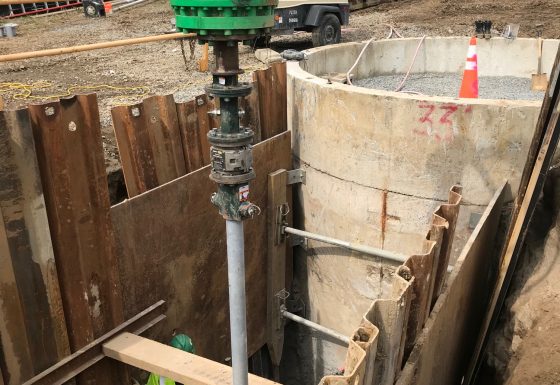
Urban sewer rehabilitation puts more constraints on your foundation system than almost any other project type. Here’s how helical piles and grouted micropiles compare to driven piles — head to head, with real project data.
The Problem: Too Many Constraints, Too Few Options
If you’ve ever specified foundations for a sewer rehabilitation or pump station project in an urban corridor, you already know the constraints. They don’t arrive one at a time – they arrive simultaneously, and every single one of them limits your foundation options:
→ Narrow streets and alleys with single-lane closures and no room for a crane pad
→ Active utility corridors with gas, water, electric, and fiber within feet of your pile locations
→ Vibration-sensitive structures — aging masonry, historic buildings, and existing pipe infrastructure that can’t tolerate impact energy
→ Aggressive soil chemistry — hydrogen sulfide, contaminated fill, fluctuating water tables, and acidic soils that need to be considered
→ Municipal schedules with zero flexibility — road closure permits expire, sewer bypasses have daily costs, and there’s no room for concrete cure time
For decades, driven piles have been the default foundation for heavy civil infrastructure. They’re proven, widely available, and well understood by contractors and engineers alike. But when you put them in the context of urban sewer work — where all of these constraints hit at once — the limitations become difficult to engineer around.
Helical piles, grouted helical micropiles, and STELCOR® Drilled-In Displacement Micropiles were designed for exactly these conditions. Here’s how they compare.
Head-to-Head: Helical Piles vs. Driven Piles for Urban Sewer Work
| Factor | Driven Piles | Helical Piles / Micropiles |
| Equipment Footprint | Crane + leads, pile hammer, generator. Requires dedicated crane pad and clear overhead. Typical setup footprint: 30–40 ft. | Mini excavator with hydraulic drive head. Fits in alleys, between structures, on active roadways. Portable hand-held units available for extreme access constraints. |
| Vibration & Noise | Impact hammers generate measurable vibration transmitted through soil to adjacent structures and utilities. Vibratory drivers reduce but do not eliminate ground vibration. High noise levels create a nuisance for the surrounding neighbors. | Zero vibration. Helical piles are screwed into the ground — no impact energy. Safe to install within feet of active gas lines, water mains, and fiber optic conduit. Normal conversation-level noise. |
| Schedule Impact | Mobilization: 1–2 weeks for crane and equipment. Concrete piles require cure time (7–28 days) before loading. PDA testing adds additional schedule time for capacity verification. | Mobilization: days, not weeks. Install and load the same day — no cure time. Real-time torque monitoring provides verified capacity during installation. Crew can demobilize and the project moves forward immediately. The same equipment used for excavation can be used for installation, eliminating mobilization costs. |
| Capacity Verification | Pile Driving Analyzer (PDA) testing or CAPWAP analysis. Requires separate mobilization, instrumented piles, and post-processing. Results can lag installation. | Real-time torque-to-capacity correlation on every pile installed. The engineer gets verified bearing data during installation — not after. Results are instant. |
| Soil Displacement & Spoils | Driven piles displace soil laterally and can cause ground heave, affecting adjacent utilities. Concrete piles may require pre-drilling and spoils removal. | Minimal soil displacement. Helical and STELCOR® micropiles produce no spoils and no cross-contamination — critical in environmentally sensitive sewer corridors. |
| Depth Flexibility | Pile lengths are predetermined. Field adjustments require splicing or cutting, adding time and material waste. | Segmented, extendable shafts. Extensions are added as needed during installation to reach bearing strata. No waste, no field-splicing concerns. |
Going Deeper: Why These Differences Matter in Sewer Work
Vibration: The Non-Negotiable Constraint
In most commercial foundation work, vibration is a consideration. In urban sewer work, it’s a hard constraint that eliminates options. The typical urban sewer corridor has active gas mains, water lines, electrical ductbanks, and telecommunications conduit running parallel to and crossing the sewer alignment — often within 3 to 5 feet of pile locations.
Impact pile driving transmits energy through the soil that can separate pipe joints, crack aging masonry, and trigger settlement in adjacent structures. Even vibratory pile drivers, while quieter, still produce ground vibration that must be monitored and managed.
Helical piles eliminate this concern entirely. The installation process applies rotational torque to advance the pile — there is no impact energy, no ground vibration, and no risk to adjacent infrastructure. This isn’t a theoretical advantage. Danbro’s installer network has completed sewer foundation work within feet of active utility lines in some of the most congested corridors in the Northeast in cities like Boston, Philadelphia and Washington, D.C. This includes the projects we completed on the Meadowmere sewer reconstruction in Queens, NY, where micropiles were used to support ductile iron and ESVP gravity sewers in a dense residential neighborhood.
Schedule: Same-Day Capacity vs. Weeks of Waiting
Municipal sewer projects are schedule-driven in ways that private commercial work typically is not. Road closure permits have hard expiration dates. Sewer bypass pumping has daily costs that accumulate fast. Traffic management plans are approved for specific windows. Every day of foundation work that extends beyond the plan creates cascading cost and compliance impacts.
Driven concrete piles require cure time before loading — typically 7 to 28 days depending on mix design and loading conditions.
Helical piles deliver verified capacity on the day of installation. Every pile is monitored with torque indicators during installation, and the torque-to-capacity correlation provides the engineer with documented bearing data in real time. The contractor can install piles, verify capacity, and move to the next phase of the project — all in the same day. For municipal projects where the schedule is the single most critical constraint, this advantage alone can determine whether helical piles are the right specification.
Real Projects, Real Data
Every comparison above is backed by Danbro’s project portfolio. Here are the sewer and utility infrastructure projects that prove the performance:
Meadowmere Sewer Reconstruction — Queens, NY
IDEAL® micropiles were used to support ductile iron and ESVP gravity sewers in one of New York City’s most constrained urban corridors. The project required foundation installation in tight residential streets with active utilities in every direction. Driven piles were not viable due to vibration restrictions and access limitations. Micropiles were installed with compact equipment, provided same-day capacity verification, and allowed the sewer reconstruction to proceed on schedule. Read the case study.
Opal Street — Philadelphia, PA
Helical piles provided the foundation solution for the reconstruction of 430 feet of aging sanitary sewer on Opal Street in North Philadelphia. The tight 30-foot street and the presence of vibration-sensitive structures and active utilities ruled out driven timber piles, allowing for the successful, low-impact. Read the case study.
Municipal Water & Sewer Projects — Northeast & Mid-Atlantic
Danbro and our installer network have supported urban sewers and infrastructure for municipalities and authorities across our 17-state territory, including projects for PSE&G, Atlantic Electric, PECO, Delmarva Power, National Grid, Eversource, and Covanta. Each project reinforced the same conclusion: in constrained urban environments with aggressive soil conditions and tight schedules, helical piles and grouted micropiles outperform driven piles on the criteria that matter most.
When Driven Piles Still Make Sense
This comparison is specific to urban sewer infrastructure — not a blanket statement about foundation selection. Driven piles remain an excellent solution for projects with open site access, very high axial loads exceeding helical capacity ranges, dense or rocky bearing strata requiring impact energy to penetrate, and conditions where vibration, access, and schedule are not primary constraints.
The point isn’t that driven piles are inadequate as a foundation system. The point is that urban sewer work creates a specific combination of constraints where helical piles and grouted micropiles consistently deliver better outcomes — faster installation, zero vibration, structural corrosion protection, and verified capacity on the day the pile goes in.
The Bottom Line for Specifying Engineers
If you’re specifying foundations for an urban sewer rehabilitation, pump station, water treatment facility, or utility infrastructure project, the comparison comes down to this: which system can deliver verified capacity in a constrained urban environment, with zero vibration and same-day installation?
The answer, backed by decades of project data across the Northeast and Mid-Atlantic, is helical piles and grouted micropiles.
Danbro Distributors provides engineering support, product selection guidance, and installer referrals for sewer and utility infrastructure projects across our territories. Whether you’re in the early design phase or ready to specify, we can help match the right foundation system to your project’s specific constraints.
Have an upcoming sewer or utility infrastructure project? Contact Danbro Distributors for engineering support and product selection.




No comments yet.