


There’s a moment on nearly every challenging foundation project when the geotechnical report lands on the table and the standard playbook stops working. Poor soils at shallow depth. Contaminated fill that can’t be disturbed. A cofferdam already sheeted. Active infrastructure overhead or adjacent. These are the conditions where STELCOR® Drilled-In Displacement Micropiles were purpose-built to perform — and the load test data backs it up.
As the exclusive regional distributor for IDEAL Foundation Systems across our territory in the Northeast and Mid-Atlantic, Danbro Distributors has supported STELCOR installations on projects ranging from active transit rail platforms to Navy fabrication facilities to municipal pump stations. Here’s a technical look at how the system works, where it excels, and what the real-world numbers look like.
How STELCOR DDMs Work
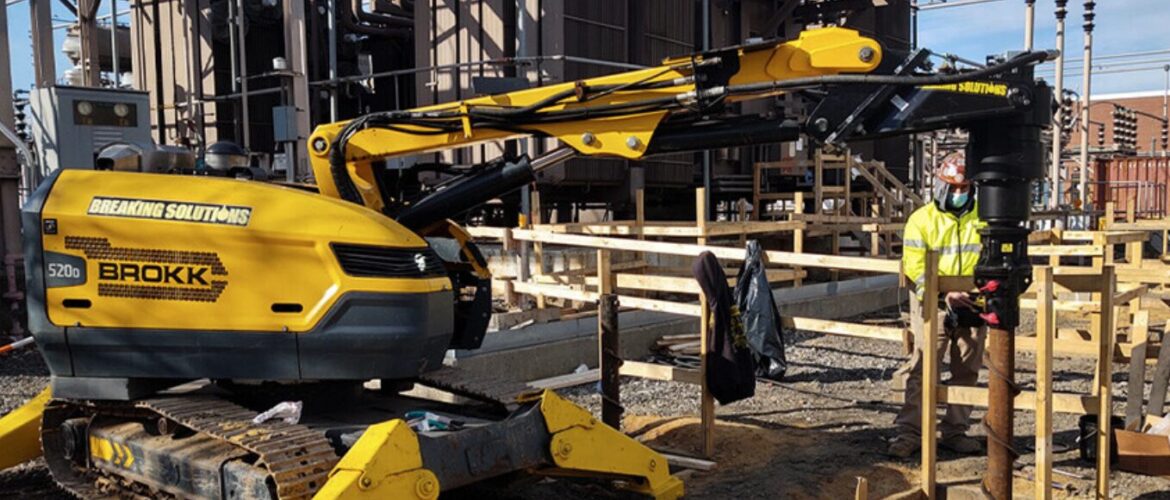
STELCOR is installed using any hydraulic-powered rotary drive head, typically mounted to an excavator or skid-steer. A continuous flow of grout is introduced at the top of the pile as the steel core is rotated into the ground under crowd pressure. What distinguishes the system mechanically is what happens at the tip.
The STELCOR displacement lead section consists of three elements working in concert. A driving plate advances the pile axially and provides end bearing. A lateral displacement plate pushes soil outward rather than removing it, creating a positive annulus around the steel core while densifying the surrounding material — which directly enhances grout-to-ground bond strength. A secondary deformation structure produces a ribbed or corrugated effect along the grouted shaft, further increasing load transfer capacity along the pile length.
Reverse grout flow flighting welded to the steel core draws grout into this annulus from top to bottom, ensuring a continuous, uninterrupted grout column. Grout ports in the steel core provide additional placement consistency along the pile’s full length. The 80 ksi steel core remains in the ground permanently, running the full length of the pile to maintain unbroken structural integrity for both axial and lateral loading.
No soil is removed during installation. That single design decision eliminates spoil handling costs, prevents cross-contamination risk, and removes the schedule exposure associated with spoil disposal — especially on brownfield or environmentally sensitive sites.
Structural Capacities
STELCOR has been designed and tested to the following ultimate loads without failure:
- 620 kips — Ultimate Compression Load
- 600 kips — Ultimate Tension Load
- 40 kips — Lateral Load
These are not theoretical design values. They represent documented load test results. In our experience across the Northeast and Mid-Atlantic, STELCOR has consistently delivered higher-than-expected capacity, particularly in compression and tension at shallow installation depths — a critical advantage when soil conditions deteriorate quickly below grade.
Where STELCOR Outperforms Conventional Micropiles and Auger Cast
The design wins in specific project scenarios that occur regularly throughout our territory.
Contaminated soils. Because STELCOR displaces soil laterally rather than extracting it, no spoils are generated at grade. On contaminated sites in urban areas — and there are a significant number of them across Philadelphia, New York, Baltimore, and throughout New Jersey — this eliminates the permitting requirements, disposal costs, and liability exposure associated with soil extraction. The lateral displacement also prevents cross-contamination between soil strata.
Sheeted cofferdams and limited headroom. STELCOR can be installed with as little as 10 feet of overhead clearance without meaningfully impacting installation rate or complexity. Unlike auger cast piles, which require staged removal as excavation proceeds, a STELCOR DDM can be installed after a cofferdam is fully sheeted and excavated — eliminating a second mobilization entirely.
At the Cedar Point Lake Pump Station in Woodmere, New York, the original design specified auger cast piles. The contractor, working within a sheeted cofferdam, value-engineered the foundation to STELCOR DDMs in coordination with the structural engineer (Gannett Fleming) and design engineer (Gencorelli Engineering). Twenty STELCOR piles with a 5.5″ steel core and 12″ grout column were installed to 35 feet, achieving 60 kips compression, 40 kips tension, and 8 kips lateral. The single-mobilization installation was the deciding factor operationally.
Active environments with vibration sensitivity. STELCOR installation generates no vibration. This is a hard requirement on projects adjacent to existing structures, within operational facilities, or — as was the case at the SEPTA Conshohocken rail platform expansion — next to live transportation infrastructure. A single STELCOR pile was installed to 18 feet achieving 128 kips ultimate capacity, with active SEPTA trains passing throughout the construction window. The installation crew, inspecting engineers, and SEPTA representatives coordinated directly on safe work protocols throughout the project.
High axial demand at shallow depth. STELCOR was specifically engineered to achieve high compression and tension capacities without requiring the pile depths that other foundation systems demand. On projects where bedrock or competent bearing strata are not accessible within a reasonable depth range, the combination of the densified annulus, ribbed shaft geometry, and full-length 80 ksi steel core allows STELCOR to mobilize meaningful skin friction and end bearing in poor or intermediate soils.
Design Parameters
STELCOR DDMs are designed and installed as displacement piles in accordance with the International Building Code (IBC) and applicable local jurisdictions. One or more of the following patents apply: US 8,926,228 B2 and US 10,480,144 B2.
Recommended grout mix is 0.44 water-to-cement ratio (W/C), using one 94 lb. bag of Type I/II Portland cement to 5 gallons of water. A high shear colloidal mixer is required.
Published grout take approximations by pile series are as follows (for bidding purposes; actual take will vary by soil type):
- STELCOR 1200: 0.38 cubic ft. per lineal foot (0.33 bags/LF)
- STELCOR 1400: 0.44 cubic ft. per lineal foot (0.38 bags/LF)
- STELCOR 1600: 0.67 cubic ft. per lineal foot (0.59 bags/LF)
- STELCOR 1800: 0.88 cubic ft. per lineal foot (0.77 bags/LF)
- STELCOR 2000: 1.15 cubic ft. per lineal foot (1.00 bags/LF)
Test pile installation establishes site-specific parameters — depth, grout take, and verified capacity — prior to production pile installation. This confirmation step is built into the STELCOR workflow and gives the EOR documented performance data to work from.
Installation Equipment and Mobilization Cost
The STELCOR system requires an excavator of appropriate size, a hydraulic planetary drive head in the 20,000–150,000 ft-lb torque range, and a high shear colloidal grout mixer. In most cases the excavator is already on site. There is no purpose-built drill rig, no specialty crane setup, and no complex mobilization sequence.
A 60-foot STELCOR pile — lead section plus two 20-foot extensions — can be installed in approximately 30 minutes. That translates to a realistic installation rate up to five times faster than comparable alternate deep foundation methods, which has a direct and material impact on project schedule and general conditions costs.
When developers and owners ask Danbro about cost, the most useful framing comes from a developer who put it plainly: “I want to know my cost-per-kip of support with each piling option, not my cost per foot of material.” STELCOR routinely delivers competitive cost-per-kip performance because it achieves high capacity at shallower depths with less material, less equipment, and less time.
Typical Applications
STELCOR has been used successfully on high-rise residential new construction in New York City, basement retrofits for vertical additions, sewer and drainage support in Washington, D.C., industrial facility retrofits for heavy machinery pads, government and military design-build foundation work, and boardwalk and coastal infrastructure throughout the Mid-Atlantic. The NAVFAC projects at the Philadelphia Navy Yard involved a design-build foundation for a machinery pad supporting submarine component fabrication equipment.
If your project involves poor soils, contaminated fill, high water table, limited access, low headroom, vibration-sensitive surroundings, or tight schedule constraints, STELCOR is worth evaluating against your current foundation approach.
Work with Danbro
Danbro Distributors has been the exclusive regional distributor for IDEAL Foundation Systems products — including STELCOR, IDEAL® Helical Piles, and Grouted Pulldown Piles — across the Northeast and Mid-Atlantic for decades. We provide direct engineering support from feasibility through design and construction, and we stock the product and equipment to support projects across Pennsylvania, New Jersey, New York, Delaware, Maryland, Virginia, West Virginia, and throughout New England.
Design manuals, cut sheets, installation records, and project feasibility forms are available at danbro.com. To discuss your project’s specific soil conditions and foundation requirements, contact our team directly.




No comments yet.