


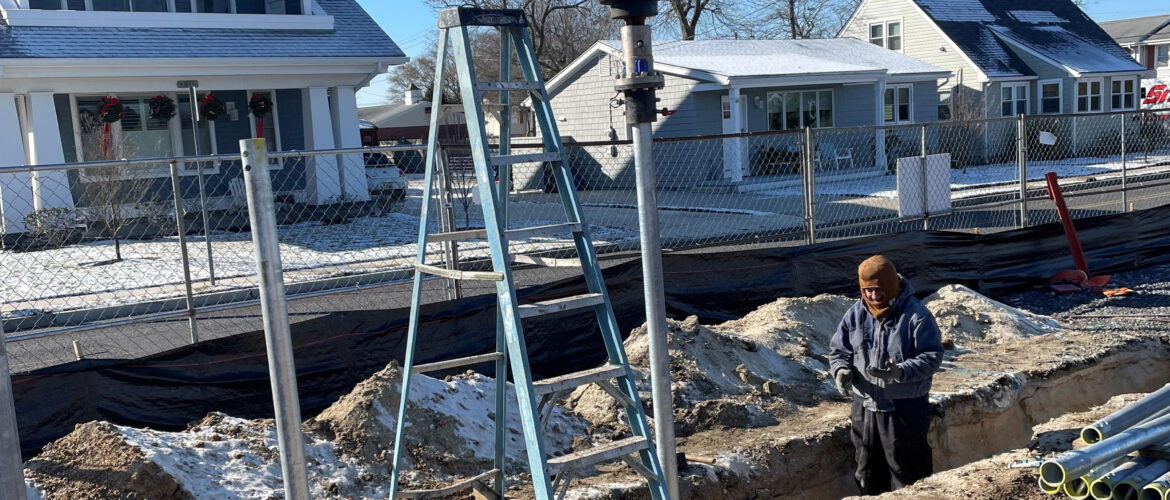
Cape May City is one of five barrier islands in southern New Jersey, bordered by the Atlantic Ocean on the east and the inland waterway and wetlands to the west. Deep foundations are required by code for many of the structures in this part of the world. Helicals have become increasingly popular in Cape May County for obvious reasons. In the City of Cape May, only helicals can be installed during the summer as they are neighbor-friendly, relatively quiet, and produce no spoils. Click here to read Madison & New York Case History.
The Cape May Police Department had outgrown their current space and needed to build a new facility. The crowded, popular tourist destination forced the city to build on a previously developed, long demolished settlement on the west side of town bordering on wetlands. Helicals were selected to deal with varying soil conditions, possible contamination, and abandoned subsurface obstructions. Helical piers avoided the need for over-excavation and possible complications that could have arisen from other deep foundation systems, including driven timber piles which would have required jetting them in, creating a mess and possible spoils.
Helicals are the preferred deep foundation element when access, mobilization, no-vibration, environmental sensitivity, or neighbor-friendly conditions are at issue. These are the usual suspects that drive structural engineers to choose helicals to eliminate, or at least mitigate, site challenges. On this project, two other helical virtues were major difference makers.
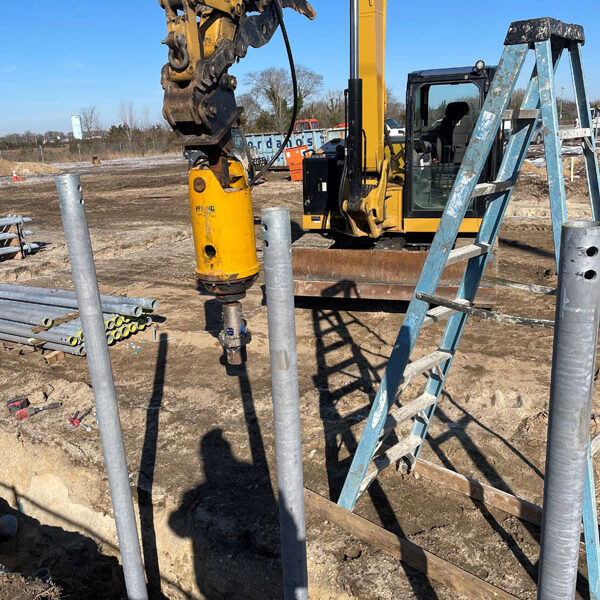
The borings confirmed that a previous settlement here left obstacles subsurface, including old footers in some locations. The borings also indicated varying soil conditions as the site bordered on wetlands with low blow counts to the west and neighbors and trash to the east. A veteran helical installer, Titan Shoring & Construction, had worked on a walkway project adjacent to this property. Titan’s experience on the “Lafayette Walkway”, adjacent to the site, told them what to expect on the west side of the project. The east side presented some obstructions and trash, but Titan was prepared and armed with the adaptability of helical technology. Click here to read Lafayette Trail Case History.
Every helical installer depends on the Torque to Capacity relationship as a reliable field test to confirm capacity at a prescribed depth as indicated by the borings. Helicals are adept at dealing with some obstructions and can fight through uncompacted trash. A helical pile will spin out and walk around a small boulder or a small obstruction the size of a breadbox. It will pass and get back on center as the helices clear and the extensions come into play. At several locations, old footers were encountered and removed, but the flexibility of helicals and reliance on the torque to capacity relationship insured a solid foundation without the need for over-excavation that would have been necessary with other deep foundation systems. Within limits, and with the Structural Engineer’s permission, the spacing of helical piles can be adjusted, avoiding obstructions, and piles added (if necessary) to avoid over-excavation and spoils.
Depths at this site varied between 15’ and 37’. Kevin Pendergast, Titan owner/operator, a seasoned professional, knew the difference between torque spikes, indicating an obstruction or trash, and consistent torque readings, indicating that capacity was achieved in stable soil. The foundation was completed on time and on budget with no delays due to subsurface conditions.


No comments yet.